Stop Picking Etsy Niches by Guessing. Read Your Competitors' Reviews With AI Instead
Your next product idea is already written down, in your competitors' reviews. Here's how to feed those reviews to AI, find the complaint nobody else is solving, and turn it into a listing. Two copy-paste prompts included.

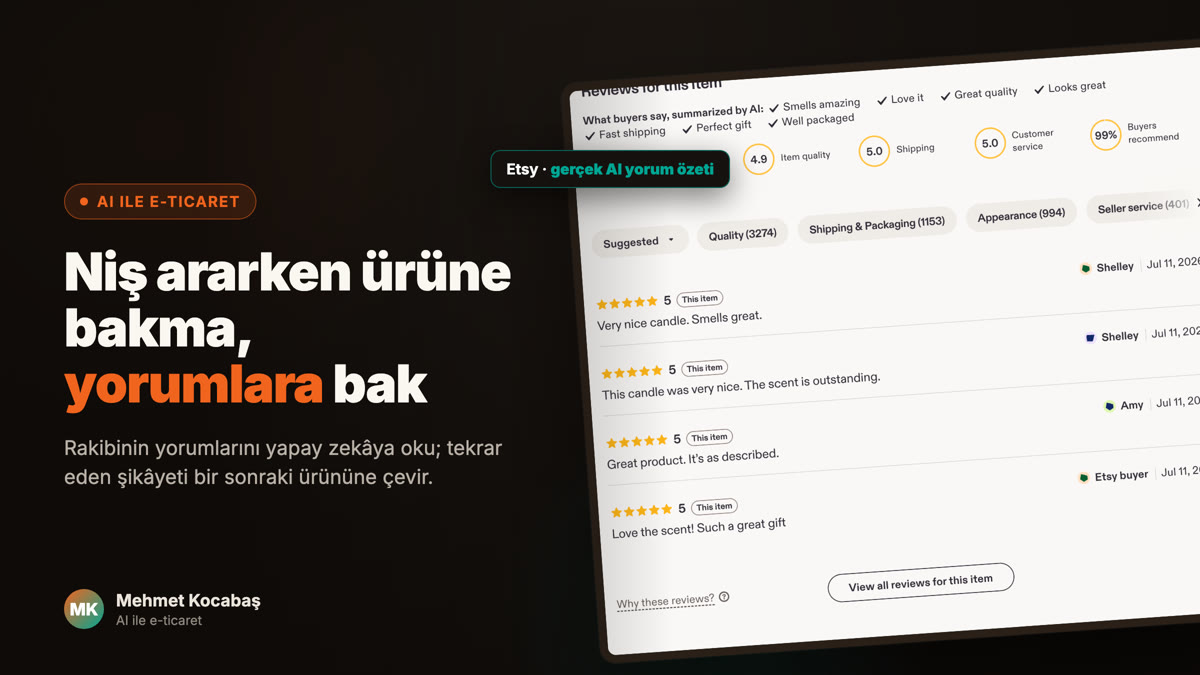
Stop staring at the product when you're hunting for a niche. Look at your competitors' reviews instead. Everyone else is checking photos, pricing, and sales counts, and none of that is where the real ore is. Reviews are the one place customers write down what they want in their own words. See a complaint show up again and again, and you've just found your next product. You're not guessing at product ideas anymore, the customer is handing them to you. Below is the method, step by step, with two copy-paste prompts dropped right into the steps where you'll use them.
Where everyone looks, and where nobody reads
When most sellers hunt for a new product, the reflex is always the same: check the competitor's listing, check the price, check how many they've sold, then try to make something similar. The problem is everyone else is checking the exact same things. That's how you end up with a market full of identical products at identical prices, all fighting for the same customer.
Meanwhile the customer is telling you exactly what they want. In the reviews. Someone bought the product, used it, and ran into something that fell short, so they wrote about it. Enough people mention the same gap, and it stops being a coincidence. It becomes an opening, and that opening is yours to take. The only catch used to be that spotting it meant reading hundreds of reviews one at a time. That took days. It doesn't anymore.
The surface question and the one underneath it
- The surface question: "What is my competitor selling?" That's the visible part, the part anyone can copy.
- The real question: "What did my competitor's customer never get solved, and how do I step into that gap better than they did?"
Real product research answers the second question. The first one just turns you into another copy in a crowded market. The second one hands you an actual edge. Review analysis answers exactly that second question, because the unsolved problems are sitting right there, in the customer's own sentences.
How this used to work, and how it works now
Reading a niche's reviews used to be a slog. You'd open hundreds of them one by one, take notes, try to group patterns in your head. A day would disappear and you'd be left with a vague feeling instead of a clear decision.
Now you hand that job to AI. Collect your competitors' reviews, paste them into a prompt, and the AI groups everything by theme: how many people are annoyed by what, which complaint is the obvious one everyone already sees, and which one nobody's touched yet. Hundreds of scattered reviews turn into a ranked list in seconds. You're not doing the grunt work anymore, you're reading the output and making the call.
The method, in 3 steps
1. Pick your competitors. Five to ten top sellers in your niche is enough. Go for shops with real review volume and some history behind them, more reviews means a clearer signal. Set yourself a 60 minute timer and stop when it goes off. This is a scouting run, not an endless reading marathon.
2. Collect the reviews. Etsy doesn't have a bulk export option for competitor reviews built into its seller tools, they sit one by one on each shop's listing pages. Don't try to grab everything. Pull the visible reviews from your top 5 to 10 competitors, and lean especially hard on the 2 to 4 star ones. That's where the "I wish it had" sentences show up. Five star reviews won't show you a gap, they just say "it was great." (Third-party browser extensions exist that speed up the collecting, but doing it by hand is fine to start. You're not trying to hoard data, you're trying to spot the complaint that keeps repeating.)
3. Let AI pull the pattern out. Two prompts do this. The first one boils the reviews down to repeated complaints. The second one turns whatever gap surfaces into a concrete product. Both are below, run them in order.
Prompt 1: Turn reviews into complaints
Paste the reviews you collected into the prompt below and run it in ChatGPT or Claude. Swap [NICHE] for your category, and drop your collected reviews into the [paste competitor reviews here] spot. Leave the rest as is.
Below are customer reviews for competing products in the [NICHE] category.
Your job: pull out repeated complaints and unmet requests.

1. Group the reviews by theme (scent, wick, packaging, durability,
   size, ease of use, etc).
2. For each theme: how many reviews mention it, plus one example quote.
3. Split them into two buckets: which is the obvious complaint everyone
   already sees, and which is a repeat nobody has addressed?
4. Tag each one as either "unmet need" or "one-off gripe."

Only report what actually shows up in the reviews, don't invent anything.

REVIEWS:
[paste competitor reviews here]
Zero in on whatever theme comes back tagged "repeat nobody has addressed." That's your opening.
Prompt 2: Turn the complaint into a product
Take the gap complaint that came out of the first prompt and drop it into the one below. Swap [COMPLAINT] for a single repeated complaint (for example, "the jar cracks in shipping"). The AI turns it into a concrete product, selling points, and a title.
Turn this repeated complaint into a product opportunity: "[COMPLAINT]"

Give me:
1. A concrete product or variant that solves this complaint (1 sentence).
2. Three selling points to highlight, in the reviewers' own language.
3. Three listing title options that lead with the fix.
4. One piece of proof to show in the first photo (something that
   demonstrates the complaint is solved).

The customer already told you what they want in their own words,
use that language, don't fall back on marketing cliches.
A real example: the candle niche
Say you sell candles. You feed your competitors' reviews to the AI and it comes back with three themes:
- Scent is too weak: shows up in 8 reviews. This is the complaint everyone sees, and everyone's already competing on it.
- Jar cracks in shipping: shows up in 5 reviews. Nobody's touching this one.
- Wick smokes and burns crooked: shows up in 4 reviews. Also untouched.
The easy answer is "I'll make the scent stronger." But that's the crowded lane, everyone's already piling in there. The real opening is in the repeats nobody's addressed: shipping and the wick. That's where your next product gets born, a soy candle with a smoke-free wood wick and a thick jar that won't crack in transit. Even the title writes itself straight from the reviewers' own words: "Smoke-Free Wood Wick Soy Candle, Thick Shatterproof Jar."
You didn't guess at the product idea. The customer wrote it for you.
This method isn't tied to one niche, either. Run it on jewelry and the AI maps out something similar: "chain tarnishes" is the obvious complaint everyone sees, "clasp keeps popping open" is the repeat nobody's touched. Product: a necklace with a stronger, more secure clasp. The niche changes, the method doesn't.
Before you make anything, verify the gap
If you've been at this a while, you already know: a repeated complaint isn't automatically proof of demand. Run it through three questions before you commit to production:
- Is anyone already selling the fix? Search Etsy and Google for that solution. If nothing shows up, there are two possibilities: either it's a genuinely early opportunity, or there's just no demand for it. Run a small test to figure out which, don't dump your whole budget into inventory.
- Does the margin hold up? A wood wick, a thicker jar, all of that costs more. Does your price cover that cost and still leave you a profit?
- Is it more than 5 repeats? One or two mentions is noise, not signal. Once at least 5 people are writing the same thing, it's worth building around.
Anyone can run this prompt. What separates you is being the first to actually close the gap. Find it, build it fast, be first to market. I won't sell this as a get-rich-quick trick, it's an afternoon's worth of work. But an afternoon beats weeks spent guessing.
Take this with you
- Chase the complaint nobody's addressing, not the obvious one. That's where the gap sits.
- Focus on 2 to 4 star reviews. Five or more repeats is your signal.
- Verify before you build: does the fix already sell, does the margin hold up.
- No invented numbers. Only count what genuinely shows up in the reviews.
- Don't copy the design or the copy. Take the idea, build your own brand around it.
Both prompts are up above, sitting right inside the step where you'll use them. Copy them, run them against your own niche. Your next product idea doesn't have to come from your own head, it's sitting in what the customer already wrote you.
Frequently asked questions
Do I need an expensive tool to analyze competitor reviews?
No. Your competitors' reviews are public, sitting right there on their listing pages. All you need is to collect the visible reviews from your top 5 to 10 competitors and hand them to an AI with the right prompt. Etsy doesn't offer bulk review export in its own seller tools (third-party browser extensions exist but aren't required), so don't try to grab everything. Focus on the sellers you get compared to most, and pull their 2 to 4 star reviews especially. That's where the 'I wish it had' sentences live.
I found a repeated complaint. Should I start making the product right away?
No, verify it first. A repeated complaint isn't automatically proven demand. Before you commit to production, ask three questions: Is anyone already searching for or selling that fix? Does the cost of solving it still leave you a margin? Does the complaint show up in more than 5 reviews, or is it just noise from one or two people? If all three check out, go ahead.
Which reviews should I actually focus on, the 5 star ones?
The 2 to 4 star reviews. A 5 star review says 'everything was great,' which tells you nothing about the gap. The real signal sits in the middle: a customer who bought the product, mostly liked it, but ran into one thing that fell short, and says so in their own words. Skip the obvious complaint everyone already sees (say, 'the scent is weak' on a candle) and hunt for the repeat nobody's touched. That's where the opening is.
Isn't pulling a product idea from a competitor's reviews just copying them?
No. Copying means lifting someone's design or listing copy, and that's a copyright issue. What you're taking here is a gap your competitor hasn't closed, which is an idea, not their intellectual property. You're meeting the same complaint with your own original product that solves it better. Take the idea, build your own brand around it.