Selling with no stock: who is print on demand for?
With print on demand, a product only gets made once an order comes in, so you're never sitting on a pile of t-shirts. This lesson explains how the model actually works, what Printify does inside that flow, and who really makes money from it.
You want to sell a product. But you don't have the money to hold 200 t-shirts in a warehouse, you have no idea which color and size will sell, and you haven't thought about what happens to the ones that don't. This is exactly where print on demand comes in.
Print on demand, POD for short, means nothing gets produced until a customer actually orders it. You upload a design, it looks like it's already printed on a t-shirt, a mug, a poster, but nothing has actually been printed. Not until someone buys it.
The order comes first, then the production
Classic ecommerce runs in one order: you make or buy the product, put it in a warehouse, then try to sell it. If it doesn't sell, your money just sits there on a shelf.
POD flips that order: the sale happens first, then production starts. A customer orders a t-shirt from your Etsy or Shopify store, that order drops automatically into a production network, a manufacturer prints that one shirt and ships it straight to the customer. You never touch it.
The result is simple: your inventory risk drops to zero. No leftover stock, no wasted capital, no "this color never sold" headache. But it's not free of tradeoffs either, we'll get to that.
What Printify actually does in this flow
Printify doesn't manufacture anything itself. It's a connector: it puts hundreds of different manufacturers (print providers) around the world behind a single dashboard. You upload a design and say "print this on this shirt, this mug, this poster," and Printify routes that order to the manufacturer you picked, who prints it and ships it.
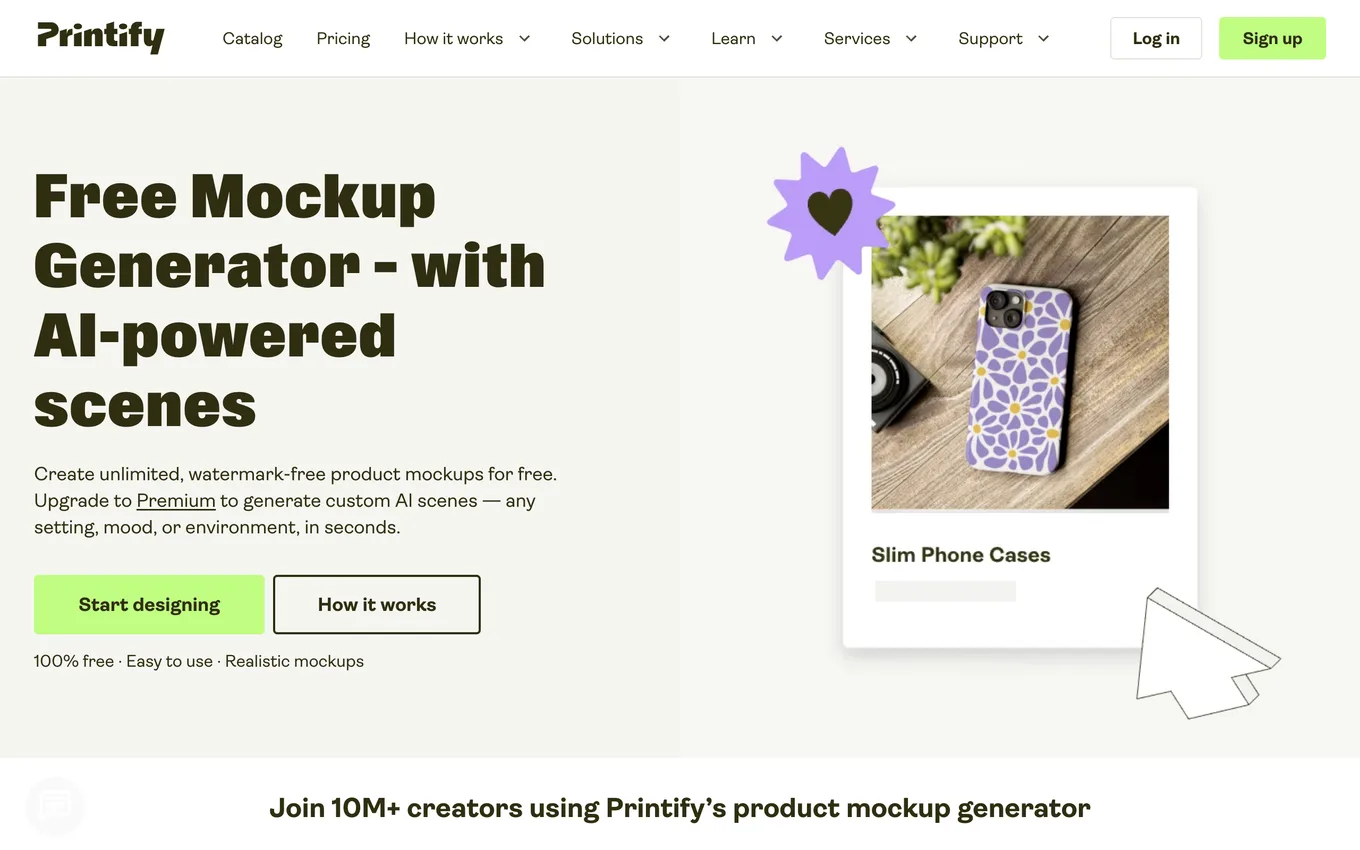
Source: printify.com, accessed July 2026.
So Printify combines three things for you: a product catalog (what can be printed on), a manufacturer network (who prints where), and store integration (automatic connection to Etsy/Shopify). You manage the design and the storefront, everything else runs on its own.
The honest part: margins are thin, and it's not all smooth
A few things I need to say straight, without overselling this.
First, margins are usually thin. The manufacturer gives you a base cost, you set your own price on top of it, but because production plus shipping tends to run higher than bulk manufacturing, your margin ends up narrower than it would with traditional stock. Check current pricing on the specific product page in Printify for the manufacturer you pick, quoting one number here would be misleading.
Second, shipping time varies by manufacturer. Some print and ship fast, some are slower, and that depends on where the manufacturer is located and how busy they are at that moment. You can see the estimated production and shipping time for your chosen manufacturer right on the product page inside the Printify dashboard.
Third, you're selling a product you've never physically seen. The mockup image on screen might not perfectly match the real product's color, fabric, or print quality. That's exactly why I'll recommend ordering a sample before you ever list a product in your store, more on that later in this course.
Who this fits, and who it doesn't
POD makes sense as a starting point if you don't have capital to produce inventory but you do have a design or brand idea. You can test with very little risk: put up a design, if it doesn't sell you've lost nothing, try again.
But it's not for someone expecting "automatic money with zero effort." Picking designs, setting up your store, pricing, answering customer questions, that's all still on you. POD takes production and shipping off your plate. It does not take sales and marketing off your plate.
Lesson checklist
- I understand that in print on demand, a product only gets made once an order comes in
- I know Printify doesn't manufacture anything itself, it provides the manufacturer network plus the integration
- I know margins can be thin and shipping time varies by manufacturer
- I accept this is a real business that needs design and marketing, not "passive income"
In the next lesson, I'll walk you through opening an account, designing your first product, and connecting it to your store, step by step.