Claude Opus 5: Better Performance, Same Price

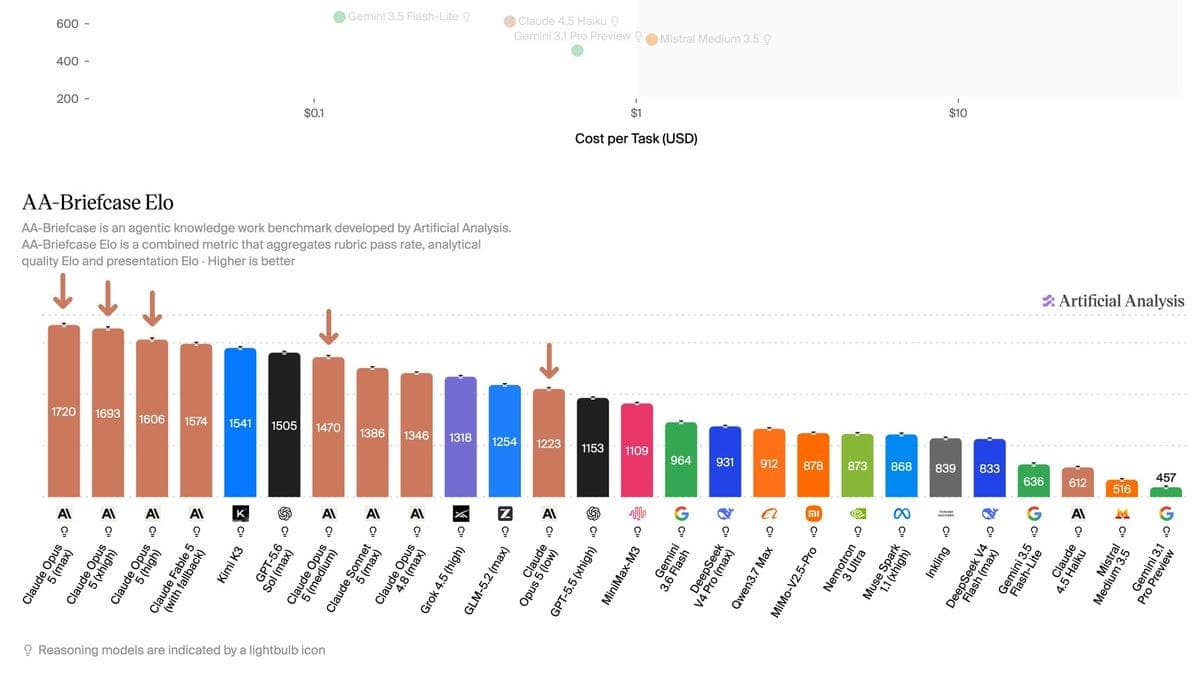
A significant development has occurred in the AI world. Anthropic's new Claude Opus 5 model has raised the performance bar, reportedly surpassing the Fable model in independent evaluations. The most striking aspect is that this enhanced performance is offered at Opus pricing, which is roughly half the cost of Fable. This presents a major advantage, especially for businesses seeking cost-effective AI solutions.
This update directly benefits entrepreneurs and SMBs integrating large language models (LLMs) into their business processes. Accessing a more powerful AI model at a more affordable cost can boost efficiency in areas like content generation, customer service automation, data analysis, and strategic decision-making. You can leverage more sophisticated AI capabilities with a smaller budget.
Opus 5's performance and pricing have the potential to democratize AI usage. Small and medium-sized businesses can now more easily access capabilities that were previously difficult to reach. This can open new doors for gaining a competitive edge and optimizing business processes.
What to do:
If you are using large language models in your business processes, examine the cost-performance ratio of Claude Opus 5. You might consider updating your existing AI integrations with this new model.
MK's take
How Claude Opus 5 Cuts AI Costs for Your Business
You can now access the same or better AI performance as the premium Fable model for roughly half the price with Claude Opus 5, letting you scale automation and content generation without blowing your budget.
Anthropic launched Claude Opus 5, and the headline is simple: better performance at the same price point as the previous Opus tier, which is about half what Fable cost. Independent evals show Opus 5 matches or beats Fable on key benchmarks. For a small ecommerce operator running daily AI workflows, this means you can upgrade your model tier without increasing your monthly AI spend.
You can now use Opus 5 for tasks like product description generation, customer support copilot, and data extraction from supplier catalogs. The cost per token stays the same as older Opus, but the output quality jumps. If you were hesitating to move from Opus to Fable because of price, that barrier is gone. You get the higher capability now at the lower price.
But don't treat this as a silver bullet. Opus 5 still has context limits and may hallucinate on niche product specs. Always validate critical outputs. The real win is that you can run more complex chains or multi-step reasoning tasks without worrying about cost per call doubling. For daily batch processing of hundreds of SKUs, this could meaningfully reduce your monthly bill.
One concrete move this week: swap your API endpoint from the previous Opus to Opus 5 and run a comparison on a sample set of 50 product descriptions. Check for coherence, accuracy, and tone. If it holds up, redirect your full workflow. The pricing is identical, so there is no downside to testing.
Turn this into your workflow: Evaluate an AI Investment: Real Benefit vs Hidden Cost Analysis · prompt library · automation library
Turn this into action
Evaluate an AI Investment: Real Benefit vs Hidden Cost Analysis